The church is usually empty, the light is usually poor, and the first thing you notice is not the painting but the smell of cold stone. Then your eyes adjust. The wall in front of you resolves into panels: a man in a red cloak, a horse, a hand raised in blessing, a row of faces all looking slightly to your left. You have walked into a fresco cycle, and nobody has told you where to begin.
That is the ordinary situation in rural Italy. Multi-panel narrative painting is not a rarity kept behind glass; it is the standard decoration of hundreds of small churches, abbeys and mountain chapels, many of them painted by workshops whose names we will never know. What follows is a way to read them without a degree in iconography.
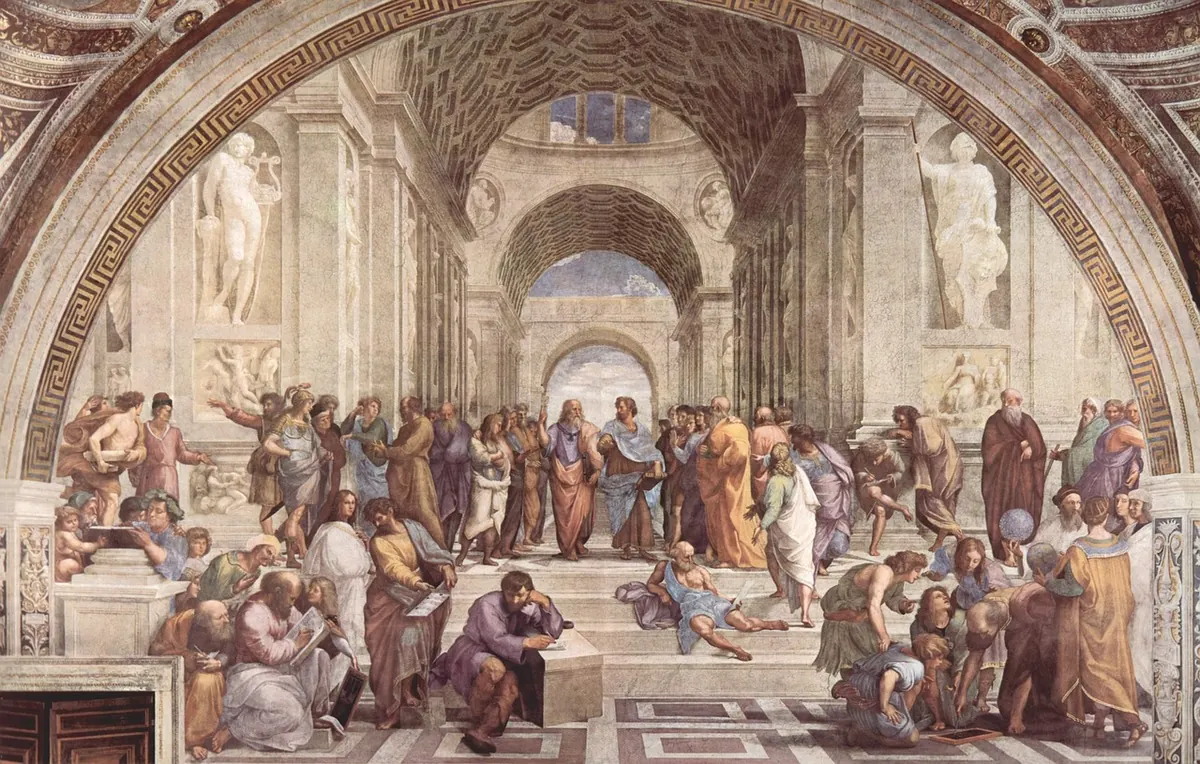
A fresco is paint applied to wet lime plaster. The pigment sinks into the lime as it cures and becomes part of the wall rather than sitting on top of it. Because the plaster sets within a day, the painter works in patches — giornate, "days" — and the seams between them are still visible if you stand close. Underneath, on the rougher coat, you often find a red-brown preparatory drawing called a sinopia. Learn to see these two things and you stop looking at a picture and start looking at a job of work.
A cycle is something more than a set of pictures. It is a planned sequence in which the scenes are chosen, ordered and sized to make an argument. The most common programmes are the life of Christ, the life of a local saint, and the pairing of Old Testament episodes with New Testament ones, so that a sacrifice in one panel answers a sacrifice in another. A Last Judgment, when there is one, normally occupies the inner west wall, so that you meet it on the way out.
City cycles were commissioned by guilds and banking families with money to spend on novelty. Rural cycles were commissioned by a monastery, a confraternity, or a village that had raised a sum and wanted as much painted surface as it could get for it. That produces recognisable habits. Figures are flatter and more repeated; the same face may serve three characters in the same band. Space is described with stripes of colour rather than with perspective. Inscriptions are short, sometimes in dialect, sometimes in Latin copied imperfectly.
None of this is failure. A village cycle was expected to be legible, durable and comprehensive, not ingenious. And most rural walls are palimpsests: an earlier painting underneath, a later one over the top, whitewash during a plague year, scraping during a reform, a baroque altar built against the middle of a thirteenth-century scene, a window punched through in the eighteenth century. Reading a rural cycle means reading a document that has been edited by everyone who came after.
You do not need a reference library to start. Ask these in order, and the wall will usually explain itself.
Find the figure who appears in every panel, or nearly every one, and identify them by attribute rather than by face: the keys for Peter, the ox for Luke, the torn cloak for Martin, the stigmata for Francis. Once you have the protagonist, the choice of episodes stops looking random.
Scenes are arranged in horizontal bands, called registers, and the sequence usually runs from the top register downward, reading left to right within each band. That is the common convention, not a law; some cycles begin at the bottom, and paired cycles face each other across the nave. Rather than guessing, find one scene you can name with certainty — an Annunciation, a Crucifixion, a martyrdom — and work outward from it in both directions.
The apse is the doctrinal centre, usually Christ in majesty or a standing Virgin. The triumphal arch carries patron saints, who are effectively the owners of the building. The nave carries story. The counterfacade carries judgment. When you know what a surface is for, a confusing wall becomes a floor plan.
Look at the bottom corners. A small kneeling figure at the foot of the cross, a coat of arms, a line of inscription with a date and a name: that is the patron, and their position in the composition tells you what they thought they were buying. A donor placed inside the sacred scene is claiming closeness. A donor placed outside it is claiming humility. Both are claims.
Blank plaster, exposed sinopia, a hard rectangular edge where a monument was removed, a patch of flat nineteenth-century repainting. Damage is information. It tells you which parts of the church were damp, which were fashionable at a given moment, and which scenes a later community found embarrassing enough to cover.
Opening hours at rural churches are unreliable. If the door is locked, ask at the parish house or the nearest bar; there is often a keyholder a hundred metres away and a small donation expected. Carry coins for the lighting box, since many cycles are unlit until you pay. Binoculars are more useful than a camera, because the best scenes are usually four metres above your head.
Sit down. Cycles were designed to be read from the floor, and the lower register is often the most damaged, by damp and by centuries of hands. Do not touch the plaster; skin oil and salt do real harm. And if you arrive during Mass, wait outside — the wall will still be there in twenty minutes.
Photo: janeb13 / Pixabay