The door is often unlocked, the light is usually poor, and the paint is often half gone. That is exactly what makes a rural fresco worth the trouble. These are not museum panels made to be studied at eye level under perfect lamps; they are walls that have held a village's calendar, its protectors and its fears for five or six centuries, and they were never meant to be read in one go. They were meant to be read on a Tuesday, in winter, with cold hands, while someone's baby cried at the back.
You do not need an art history degree to make sense of them. You need patience, a rough sense of the recurring cast of characters, and the habit of looking before you decide what you are seeing. What follows is the order in which it helps to look.
A fresco is painted into wet lime plaster, which means it is chemically part of the wall rather than a picture hung on it. So begin by standing back and asking where the painting sits on the architecture. In most small country churches you will find the richest work in the semi-dome of the apse, on the triumphal arch in front of it, and in a painted band running along the side walls. That arrangement is not decorative accident: it follows the movement of the liturgy from the door to the altar.
Notice the light. Many of these churches have small, high windows that throw a hard band of sun across one wall for an hour a day and leave the rest in shadow. Colour that looks mud-brown at eleven in the morning can be a clear mineral green at four in the afternoon. If a scene is illegible, walk to the other side of the nave before you give up on it. And sit down. Frescoes on the upper walls were designed to be seen from a seated or kneeling position, which is why so many figures lean and gesture toward the viewer at an angle that only works from below.
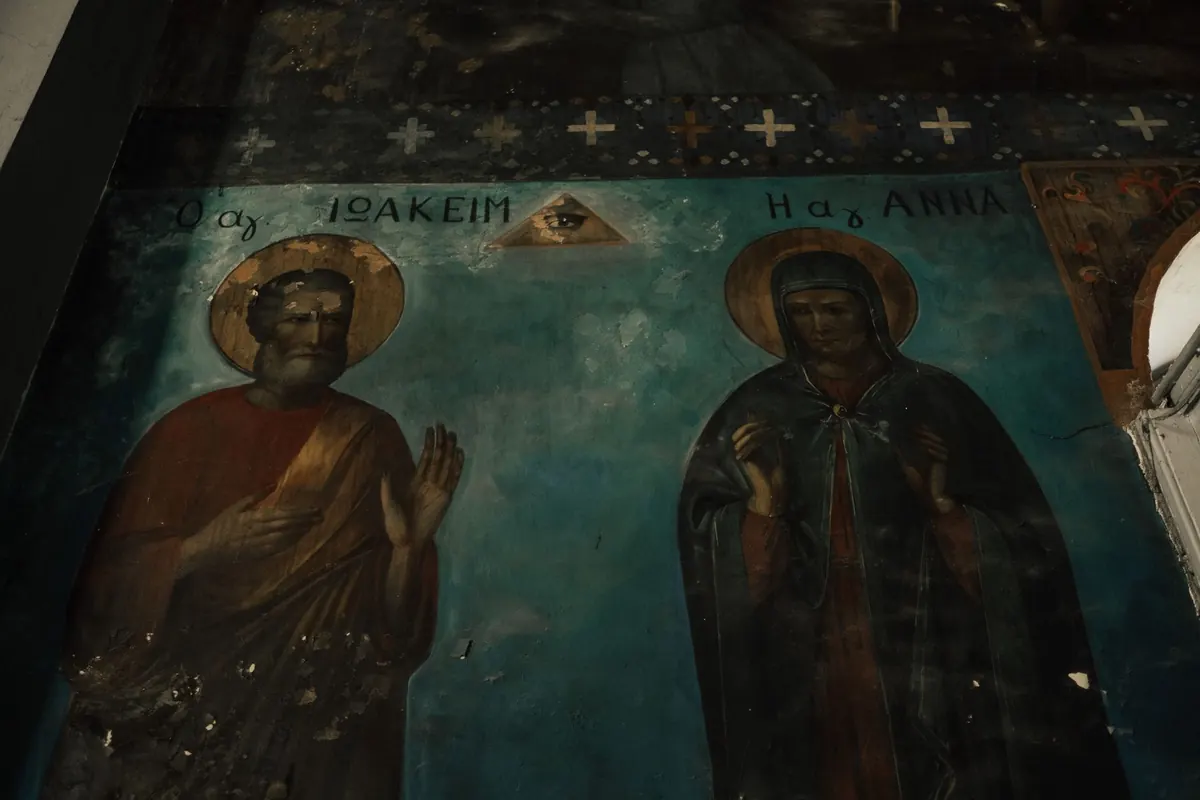
Most rural frescoes label nothing, or label it in a dialect of Latin that has partly flaked away. Fortunately, saints were painted with a set of conventions as strict as a uniform. Read the figure in this order:
Faces, by contrast, are the least reliable evidence. They were often repainted, softened by damp, or simply painted as a generic serene oval by an artist who had never seen the saint in question.
On the lower walls, under the sacred scenes, you often find a band of small square panels showing work: pruning vines, shearing sheep, threshing grain, treading grapes, slaughtering a pig in December. This is the Labours of the Months, a calendar for a congregation that farmed for a living. Watch for local detail — a painter in an olive-growing valley will give you olives where a northern painter gives you wheat.
Seasonal motifs also drift into the sacred scenes themselves. In a Nativity, the shepherds wear heavy cloaks if the painter is thinking of real winter nights. The Annunciation is placed in March, at the turn of the year, and John the Baptist's feast falls near midsummer, so his scenes are often full of green. Once you start noticing the crops and the weather, the sacred and the agricultural stop looking like two separate programs.
Hands do more work in a fresco than faces. A right hand raised with two fingers and thumb extended is a blessing; three fingers together can signal the Trinity. A single index finger lifted means teaching or authority, while a pointing finger directs your eye — look where John the Baptist points and you will find the Lamb.
Arms raised open at the sides is the orans posture, one of the oldest prayer gestures in Christian art, still common in rural churches long after cities had moved on to folded hands. Veiled or covered hands signal reverence, and you will often see them on figures receiving something important. Mary with arms crossed on her chest in an Annunciation is not praying so much as assenting. And a saint's foot planted on a dragon, a serpent or a small dark figure is a compressed way of saying the whole story in one vertical line.
A fresco rarely tells you everything at once. It expects you to come back, and to look at one thing properly each time.
Damage is information, not just loss. A red-brown outline under the colour is sinopia, the underdrawing, and where the finished paint has fallen away it can show you exactly how the composition was planned — and where the painter changed his mind. Thin seams between patches of plaster mark the giornate, the day's work, so you can literally count how long a scene took.
Colour shifts are clues too. Blue made from azurite often turns green with age, which is why a robe that looks sea-green may once have been the expensive blue reserved for the Virgin. Large flat areas of later, brighter paint usually mean a restoration or a patron's update. And if a saint seems to be holding the wrong object for his identity, suspect repainting rather than a mistake.
Try this the next time you stop at a small church on a country road.
Rural frescoes reward this slow, slightly untidy approach far more than a comprehensive audio guide would. Come back in a different season, at a different hour, and the same wall will give you something new: a harvest tool you missed, a gesture that suddenly makes sense, a name that finally surfaces from under four hundred years of dust.
Photo: Sami Aksu / Pexels