On the side wall of a half-forgotten chapel in the hills, a painted Virgin wears a blue mantle that has begun to curl away in small, brittle scales. A hand’s width away, the ochre of her robe looks nearly as fresh as the day it was laid down. Two colours, one wall, two very different fates — and the reason is not the pigment but the technique behind it. Fresco and fresco secco are often discussed as if they were a matter of style or regional fashion. They are really a matter of chemistry, timing, and how much a painter was willing to gamble on the plaster drying under his brush.
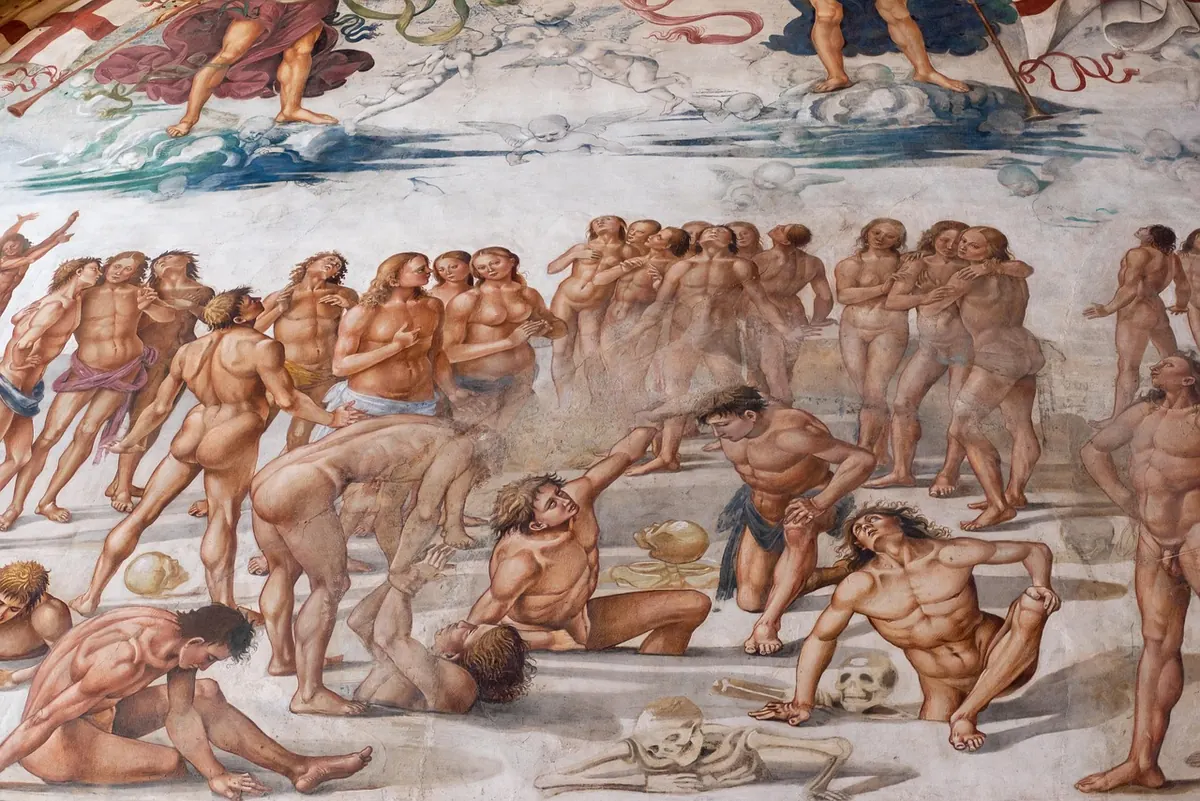
True fresco — buon fresco — means painting with pigment ground in water and nothing else, onto lime plaster that is still damp. As the lime cures, it takes carbon dioxide from the air and turns back into calcium carbonate, locking the pigment crystals inside the wall itself. There is no binder, no film, no layer sitting on top. The paint is the plaster, several millimetres deep.
Fresco secco is the opposite arrangement. The plaster has already set and carbonated; the painter mixes pigment with a binder — egg tempera, animal glue, casein, occasionally oil — and applies it to a dry surface. The colour sits as a thin skin above the plaster, held there by nothing more than adhesion. Add a third, blurry category: mezzo-fresco, painted onto plaster that is nearly set but still carbonating, where the pigment binds partly into the lime and partly sits on it.
In practice, most rural wall paintings are mixed. A village painter might lay the large fields of ochre, red earth and lime white in true fresco, then finish the faces, the brocade, the inscriptions and every blue a secco — faster, cheaper, and more forgiving of a mistake.
Fresh lime is chemically aggressive. It eats many of the pigments a painter would otherwise reach for, which is why the true fresco palette is so recognisably earthy: ochres, red and purple earths, umber, green earth, carbon black, lime white, and a handful of others that survive the alkalinity.
Working in fresco also forces a rhythm. Plaster sets on its own schedule, so the painter prepares only as much intonaco as can be finished before it hardens — a patch, a face, a section of drapery. That patch is called a giornata, a day’s work. And because lime whitens as it dries, colours laid on wet look darker than they will appear a week later; painters had to learn to judge that shift by eye.
Secco removes both constraints. The palette widens, the pace relaxes, corrections become possible. What it does not remove is fragility. A binder film dries, embrittles and slowly loses its grip, especially in a cold chapel with a leaking roof.
Blues betray themselves. Azurite and lapis lazuli, malachite, orpiment and several of the brightest greens do not take kindly to wet lime; azurite in particular tends to turn dull green or black in it. So painters routinely laid a red or grey underpainting in fresco and then floated the blue on a secco, sometimes over a thin glue size.
The result is one of the most useful field signals in rural wall painting: a blue garment flaking away in patches to reveal a warm red or grey beneath is almost certainly secco work, or at least a secco finish over a fresco base. Vivid saturated blue in an otherwise muted, earthy scheme deserves a second look. Vermilion, which darkens with light exposure, and the arsenic yellows raise similar questions. The earth colours tell you nothing — they are used in both techniques.
Secco paint fails from the top down. It lifts in small curved scales, often with a pale halo of bare plaster around each loss where the film has crept back. Hold a torch almost parallel to the wall and the lifted edges show as tiny shadows. Fresco cannot do this: pigment embedded in lime has no film to peel. It can only disappear together with its plaster.
This is the simplest test there is. If a colour is missing while the plaster beneath remains smooth and intact, the paint was a separate layer — secco, or a later addition. If the surface is broken and the rougher brown undercoat shows through, you are looking at lost fresco and lost plaster together.
True fresco is flat, matte and integrated; light falls on it as it falls on the wall. Secco often carries a faint sheen, a slightly chalky or varnished look, and under a magnifier you may see brush ridges sitting above the plaster rather than in it. Cracks behave differently too: fresco paint continues into a crack and is broken by it, while a secco film may bridge it or peel back from the edges.
Rising damp and soluble salts attack films first. Blistering low on a wall, white efflorescence pushing paint off from behind, and large areas where every colour has vanished except a few earth-red bands are all patterns that point to a weak binder. Fresco tolerates a damp countryside church far better than any glued pigment ever will.
Look for the scaffolding of the process. Giornate seams — faint ridges or slight shifts in the lime tone where one day’s patch meets the next — are strong evidence of true fresco, and they can often be traced across a large figure in low raking light. Secco passages are usually continuous. Incised lines scored through the wet plaster, pouncing dots from a spolvero cartoon, and a red-earth sinopia sketch revealed where the top layer has fallen away all describe a fresco workshop at work. Later repainting across an older image is extremely common in small country churches; a patch of suspiciously smooth, opaque colour over an old loss is usually secco, and usually much newer than the wall around it.
Record it and leave it alone. Photographs, measurements, a short written note on condition, and a rough sketch of where the painting sits in the building are worth more than any amateur cleaning. Water, household sponges and even soft brushes can drive pigment and salts deeper or tear a fragile secco film away in sheets.
The most useful thing anyone can do for a painted country wall is fix the roof and let the masonry breathe. Ventilation and a dry building save more paint than any treatment. If the painting matters to you — a chapel you maintain, a farmhouse wall you have inherited — ask a wall paintings conservator to look at it, and in Italy check with the local heritage office before any work is done, since historic wall paintings carry legal protection. A short assessment now, with photographs and a condition report, is cheap against the cost of a loss that cannot be reversed.
And the next time a blue mantle peels while the ochre robe holds firm, you will know what the wall is telling you: not that the painter was careless, but that he was working fast, with a palette the lime would not accept, and finishing the job a secco.
Photo: Ri_Ya / Pixabay